Google's War on Ad Blockers: What is our next option?

If you use Google Chrome, your ad-free browsing experience is living on borrowed time. That invaluable ad blocker extension you installed years ago—the one that makes the web usable—is about to be severely crippled.
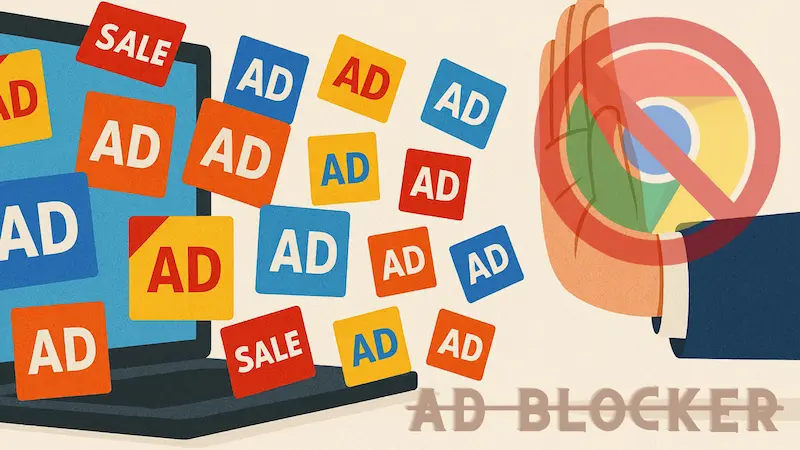
This isn't a bug; it's a deliberate change by Google called Manifest V3.
But why would Google actively make the browsing experience worse for millions of its users? How are they technically pulling it off? And most importantly, what can you do about it? Let's get straight to the answers.
- Why is Google Disabling Ad Blocker Extensions?
- How is Google Actually Killing Ad Blockers?
- Best Browser Alternatives to Chrome
- Conclusion: Your Choice Matters
Why is Google Disabling Ad Blocker Extensions?
To understand Google's motivation, you have to look at two stories: the one they tell you, and the one their business model tells you.
Google's Official Story: Security and Performance
Google claims the move to Manifest V3 is all about making you safer. Their argument is that the old system (Manifest V2) gave extensions, including ad blockers, powerful access to your network requests.
Their stated reasons are:
- Security: Malicious extensions could use this deep access to intercept or modify sensitive data, like passwords or personal information.
- Performance: The new system shifts the burden of filtering from the extension to the browser itself, which Google claims is more efficient and uses less CPU power.
- Privacy: By limiting what extensions can "see," Google argues it better protects user privacy from potential data snooping by extension developers.
The Unspoken Reason: Protecting a $200+ Billion Ad Business
Critics, cybersecurity experts, and extension developers tell a different story. The overwhelming majority of Google's parent company, Alphabet, generates revenue from one thing: advertising.
Effective ad blockers like uBlock Origin and AdGuard are a direct threat to that business model. Every ad they block is revenue Google doesn't earn.
From this perspective, the "security" argument is a convenient justification for a strategic business decision. By crippling the competition (ad blockers), Google isn't just protecting users; it's protecting its primary source of income and tightening its control over the internet's advertising ecosystem.
How is Google Actually Killing Ad Blockers?
Google isn't putting up a big "Ad Blockers Banned" sign. The method is far more technical and subtle. It all comes down to changing the rulebook for extensions, a new rulebook called Manifest V3.
The change that matters is the removal of a critical tool called the webRequest API in
its blocking form.
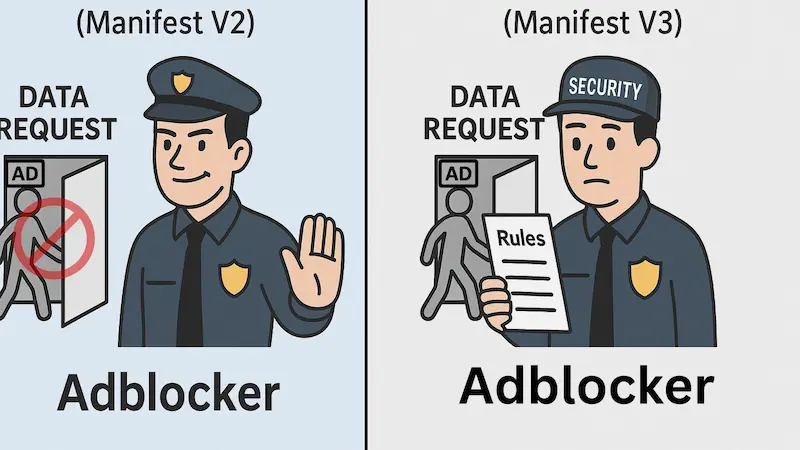
Think of it like this:
- The Old Way (Manifest V2): Your ad blocker was like a smart, proactive security guard who could inspect every person (data request) coming into a building in real-time. It used its own intelligence and a constantly updated list to spot and block threats (ads, trackers) on the fly. It was flexible and powerful.
- The New Way (Manifest V3): The security guard has been replaced. The new guard is handed a static, pre-approved list of troublemakers by the building manager (Google). They can only block people on that list. Worse, the list has a size limit, meaning it can't be comprehensive. The guard is no longer proactive; they are a simple rule-follower.
This new system, called the declarativeNetRequest API, fundamentally weakens ad
blockers. They can no longer use their dynamic and complex filter lists that made them so effective.
While some basic ad blocking will still exist,
the most intrusive and tracking-heavy ads will likely start slipping through the net.
Ad Blockers Fail: Chrome Alternatives
If a clean, ad-free internet is important to you, the best solution is to switch to a browser that prioritizes user choice. The good news is there are excellent, modern alternatives that will feel familiar and still respect your desire to block ads.
Here are the top two recommendations:
Mozilla Firefox 
As Google's main independent competitor, Firefox has publicly committed to supporting a more robust ad-blocking system. They are not beholden to an advertising business model.
- Why Switch? Firefox runs on its own engine (Gecko), offers powerful tracking protection by default, and fully supports extensions like uBlock Origin in their most powerful form.
- The Experience: It's fast, modern, and highly customizable. Importing your bookmarks and passwords from Chrome is a simple, one-click process.
Brave Browser 
Brave's entire identity is built around privacy and blocking unwanted content. It's built on the same underlying technology as Chrome (Chromium), so the user interface and website compatibility will feel identical.
- Why Switch? Brave has a powerful ad and tracker blocker, Brave Shields, built directly into the browser. You don't even need to install an extension—it works out of the box.
- The Experience: Because it's a Chromium browser, all your favorite Chrome extensions (that aren't ad blockers) will work perfectly. It offers a seamless transition with a huge privacy upgrade.
Conclusion: Your Choice Matters
Google's move with Manifest V3 is a pivotal moment for the web. It represents a conflict between a corporation's business interests and a user's right to control their own online experience.
By limiting the effectiveness of ad blockers, Google is forcing a choice upon its users: accept a web with more intrusive ads and trackers, or move to a platform that still champions user agency.
The browser market is not a monopoly. Your decision to switch sends a powerful message that privacy, performance, and user control are not features to be sacrificed for corporate profit. For the first time in a decade, the "browser wars" are interesting again, and you get to decide who wins.
Related Articles
-
![turn off smartscreen filter in microsoft edge]() How to
Turn off SmartScreen Filter in Microsoft Edge and Internet Explorer
How to
Turn off SmartScreen Filter in Microsoft Edge and Internet Explorer
-
![turn on or off smartscreen filter in Windows 10]() How to Turn on
or off SmartScreen Filter in Windows 10 Settings
How to Turn on
or off SmartScreen Filter in Windows 10 Settings
-
![change Windows smartscreen settings]() How to
Change Windows SmartScreen Settings in Windows 10
How to
Change Windows SmartScreen Settings in Windows 10
-
![enable content advisor IE]() How to Enable
Content Advisor in Internet Explorer 10/11
How to Enable
Content Advisor in Internet Explorer 10/11
-
![enable content blocker for safari in iPhone]() How to Enable
Content Blocker for Safari in iPhone
How to Enable
Content Blocker for Safari in iPhone
-
![Enable Microsoft print to pdf option]() How to
Enable Microsoft Print to PDF Option in Windows 10
How to
Enable Microsoft Print to PDF Option in Windows 10