Fix Error 0x800701B1 in Windows 10/11: USB, Drives & Setup

Error 0x800701B1 can interrupt copying to or from an external drive, access to an SSD or HDD, or the file-copy stage of Windows Setup. The message often says “A device which does not exist was specified.” The code alone does not establish whether the connection, storage device, or installation media is responsible.
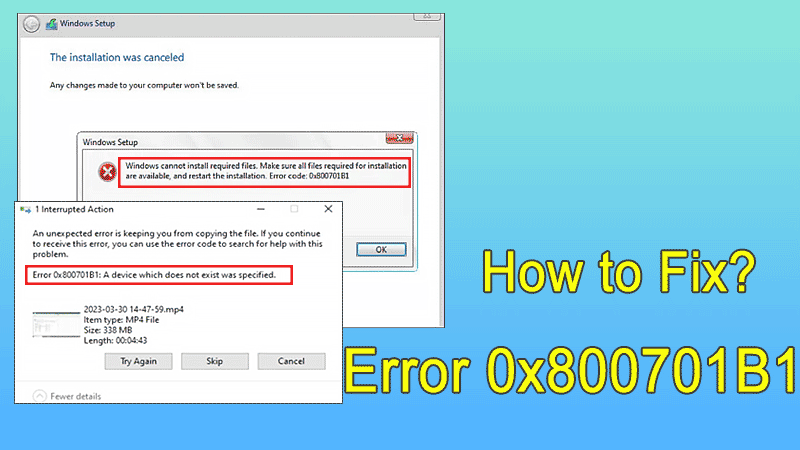
Examples from earlier Windows interfaces. These illustrate copy and Setup errors, rather than testing on a current Windows release.
Quick answer
- Check the cable, port, and power first. Then establish whether the device stays visible and readable. For Windows installation failures, test the installer USB and destination disk separately. BCD repair is not a general solution to a file-copy or device-access error.
- What error 0x800701B1 means
- Choose your troubleshooting path
- Scenario 1: USB connection problems
- Scenario 2: Device or file-reading failures
- Scenario 3: Windows installation errors
- When boot repair is a separate issue
- Frequently asked questions
- Conclusion
- Official references
What does error 0x800701B1 mean?
This code maps to the device-not-found error ERROR_NO_SUCH_DEVICE. Microsoft’s Windows SDK error definitions describe the underlying error as “A device which does not exist was specified.” A drive can initially appear in Windows and still become unavailable during an operation.
A connection interruption, an unreliable enclosure or power supply, an unreadable device, or a storage-controller problem are possibilities to investigate. Treating the code as proof of malware, incorrect ownership, or corrupt boot files can lead to unnecessary changes.
Protect files before repairing a disk
- If a disk repeatedly disconnects, makes unusual mechanical noises, or becomes extremely slow, stop repeated transfers and repair scans. Prioritize preserving important files or getting recovery help.
- Do not format, initialize, clean, or delete partitions on a drive containing needed data just because this error appears. Keep the original files until a separate backup is verified.
Choose your troubleshooting path
| Symptom | Start here | Avoid initially |
|---|---|---|
| USB drive drops out during copying. | Check cable, port, hub, and power. | A repair scan on an unstable drive. |
| Drive is visible, but file reads fail. | Check source and target; back up readable files. | A format or broad access changes. |
| Setup cannot copy required files. | Test the USB media and target disk. | BCD repair for a Setup copy error. |
| Windows cannot start and shows a boot error. | Follow the separate boot checks. | Boot repair for every device error. |
Scenario 1: USB connection problems
Follow this path when an external HDD, SSD, or flash drive drops out or reconnects during a transfer.
Try a known-good cable and direct port
Remove unnecessary extension cables, adapters, or an unpowered hub and connect the device directly to the PC. Test another functioning port and, where the cable is detachable, a compatible data cable. Change one component at a time.
A faster USB port is not automatically a fix. A charging-only cable is not a suitable data cable. Match the connection to the enclosure’s requirements; Microsoft’s USB-C troubleshooting guidance explains relevant cable, port, feature, and power limitations.
Reconnect without interrupting active writes
Step 1 Cancel the failed transfer and close applications using the external drive. Eject it if Windows allows; otherwise shut down the PC before disconnecting it.
Step 2 Reconnect securely using the tested cable and port. If access becomes stable, copy important files to a separate healthy device before retrying a large transfer.
Do not rub SSD contacts with an eraser or tissue. For internal storage, follow the manufacturer’s service instructions and disconnect power before handling hardware; these external-drive steps are not instructions to hot-plug an internal disk.
Check power and compare another computer
If the enclosure requires an external power adapter, use the specified one. Temporarily remove unnecessary external storage after ejecting it, while keeping required input devices and installation media connected.
If safe for the data, compare a known-good connection on another PC. A failure limited to one computer suggests checking that computer’s connection or driver path. Failure across multiple connections warrants device or enclosure investigation. Neither comparison alone identifies the failed part. The manufacturer’s USB recognition troubleshooting illustrates this approach.
Scenario 2: Device or file-reading failures
Both source and destination matter. Note whether opening the source file, reading other files from that disk, or writing to the destination fails. If the source remains readable, preserve essential files on another healthy destination first. Avoid repeatedly writing test files to a suspect disk containing valuable data.
Check Disk Management and device visibility
Step 1 Right-click Start and open Disk Management. Identify the affected disk by its capacity and layout, not only its drive letter.
Step 2 After checking the connection, select Action > Rescan Disks if the view has not updated. Check whether the disk stays visible.
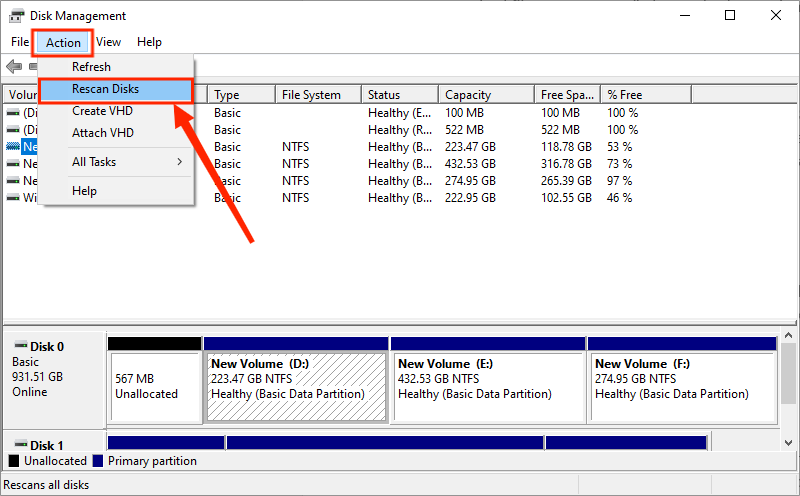
Earlier Windows interface shown. Rescan Disks refreshes discovery; it does not repair hardware or guarantee a successful transfer.
If a disk containing existing files shows as RAW, Unallocated, or Not Initialized, do not accept a format or initialization prompt. Follow a data-preservation workflow, such as recovering files from a RAW USB drive. If the disk is absent entirely, return to connection and hardware checks.
Check drivers if the problem follows one PC
If the device works reliably elsewhere, check Windows Update and the PC or storage manufacturer’s official support page for compatible USB, chipset, or storage-controller drivers. Update the identified device rather than uninstalling every disk or USB controller.
For a device-specific update, open Device Manager, identify the affected device, and select Update driver. Follow Microsoft’s driver-update instructions. Do not uninstall the running system’s storage device as a generic fix.
Limit CHKDSK to a stable, accessible volume
CHKDSK checks the file system. It cannot repair a cable or a device that keeps disappearing. First secure readable files and confirm that the volume stays connected and has a recognized file system.
Step 1 Open Command Prompt as administrator. Verify the affected volume’s letter in Disk Management.
Step 2 For a status check without repair switches, run the following example. Replace E: with the verified volume letter; do not assume E: identifies your device.
chkdsk E:This reports status rather than fixing errors. It still reads the disk, so skip even this check if physical failure is suspected or important data has not been secured. Open files on an active volume can also affect the results.
Repair switches change the file system
- Use
/fonly when the volume remains accessible, important files have a verified backup, and a file-system repair is appropriate. It changes metadata; it does not repair a faulty connection or hardware. - If the device is RAW, disappears, or repeatedly reports I/O failures, stop this procedure instead of adding repair switches or forcing a dismount.
Only for that backed-up, stable-volume repair case, the example command is:
chkdsk E: /fIf Windows cannot lock the volume or asks to dismount it, do not approve automatically. Close open files and review the affected volume first. Microsoft’s CHKDSK documentation distinguishes status checks from repair operations.
Separate permissions and security alerts from device failure
If the drive stays accessible and the actual message is Access is denied, investigate that file’s account permissions or encryption separately. Error 0x800701B1 alone does not establish an ownership problem. Do not recursively replace an entire drive’s permissions or disable security protection to troubleshoot a disconnecting device.
A security scan is appropriate when there is independent evidence of malware, such as a Windows Security alert. The device-access error by itself is not evidence of infection.
Scenario 3: Windows installation errors
If Windows Setup reports 0x800701B1 while reading, copying, or expanding required files, separate a problem with the installation media from a problem accessing the destination disk.
Re-create and retest installation media
Step 1 Record the full error and Setup stage. Retry with a known-good direct USB connection.
Step 2 On a working PC, create fresh media using Microsoft’s official installation-media instructions. For Windows 11, use its download page and media matching the target PC’s architecture.
The installer USB will be erased
- Use a blank USB drive of at least 8 GB and save anything needed from it first. Select the installer USB carefully. Creating installation media is separate from deleting partitions on the destination SSD.
Step 3 If that USB still fails, create media on a different known-good USB drive. Boot it using the manufacturer’s supported procedure and compare the result before changing the destination disk.
Check the destination disk and storage controller
Confirm that the target SSD or HDD is consistently detected in firmware and Windows Setup. If it is missing or repeatedly disconnects, investigate its connection, compatibility, and health before repeating installation attempts.
If the PC manufacturer specifies a storage-controller driver for Setup, obtain it for the exact model from the official support site and follow its Load driver procedure. Do not randomly switch RAID, AHCI, or VMD settings; that can affect an existing installation.
Do not delete partitions, format the target, or clean it with DiskPart as a default fix. If a clean installation is ultimately chosen, confirm the target disk and backups first because that separate operation can erase existing files.
When is BCD or boot repair relevant?
Investigate boot repair only for a separate startup failure, such as an existing Windows installation that will not load and reports missing boot configuration. A required-files error during Setup is not enough to diagnose damaged BCD.
Microsoft describes BCDBoot as a boot-file configuration tool. For an actual startup problem, consider Startup Repair and a procedure appropriate to that disk’s firmware and partition layout. Changing boot files does not restore a disconnected device or make unreadable installation media accessible.
Frequently asked questions
Does 0x800701B1 prove that my drive has failed?
No. Check the connection, power, enclosure, controller, and whether the device stays visible before deciding what needs replacing.
Should I immediately run CHKDSK with repair switches?
No. First stabilize the connection and protect important files. A status check and a file-system repair have different effects, and neither corrects an unreliable physical connection.
Will rebuilding BCD fix a USB copy error?
It is not an appropriate general fix. BCD is part of Windows startup configuration; a USB transfer failure should first be investigated as a device-access problem.
Why does this error appear during installation?
Setup needs reliable access to both its source media and target storage. Test them separately; the code alone does not identify which one stopped responding.
Conclusion
Follow the affected operation: stabilize USB connections, check device visibility and readability, or isolate the Windows installer and target disk. Preserve data before repairs, and reserve boot repair for an independently identified startup problem.