

Video walkthrough
See how to open a database, choose a recovery method, and use a recovered password. The video shows an earlier interface; the written guide below covers the same workflow.
![]() Watch the recovery walkthroughFollow the workflow on screen, at your own pace.Show videoHide video
Before you start
This guide covers recovering a forgotten password used to open an Access database. Keep a backup of the original file and work with a local copy that you own or have permission to access.
- Platform
- Windows 11 / 10
Full system requirements - Database files
- .mdb and .accdb
All supported formats & versions - What to prepare
- Your database file and any password clues
- What to expect
- Recovery time varies; success is not guaranteed
The images below show an earlier Windows interface. Button names and layout may differ in your installed version. They illustrate the workflow, rather than a test on a current Windows release.
Download and install Access Password Refixer, then launch it. For license details, see the purchase page. If the trial's limits are unclear, check the installed program or ask support before buying.
Step 1: Open your database
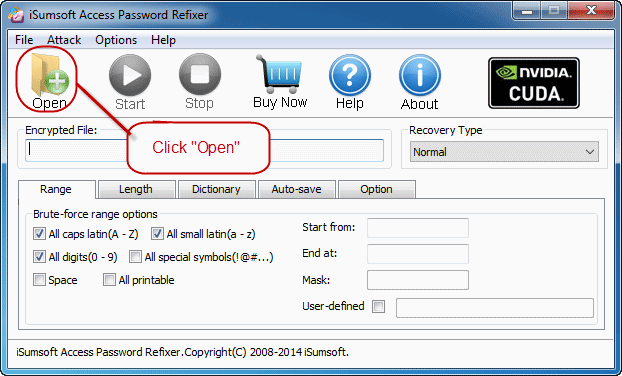
1Click Open in the toolbar to browse for your password-protected Access file.
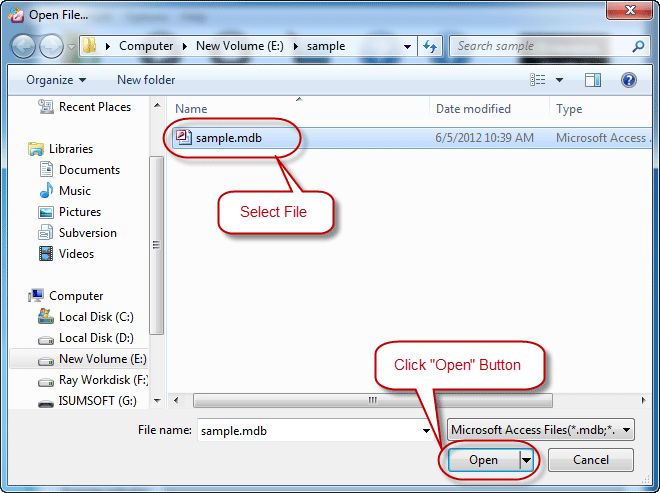
2Select the database and click Open in the file dialog. Check that the correct path appears in the program's Encrypted File field before continuing.
Step 2: Choose a recovery mode
Choose a method from the Recovery Type menu. Start with what you remember about the password.
| Mode | When to choose it | What to set |
|---|---|---|
| Mask | You remember part of the password. | Define the known characters and unknown positions. See Mask settings. |
| Dictionary | You have likely words or a list of possible passwords. | Choose a dictionary file and any variations to try. See Dictionary settings. |
| Normal | You want to search combinations within a character range and length. | Check the Range and Length settings. |
| Smart | You have no useful clues and want to try the program's automatic combination search. | Select Smart. A broad search can take a long time. |
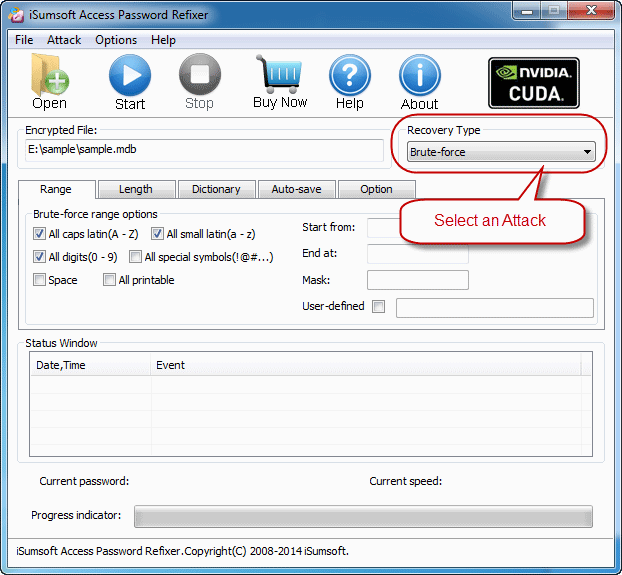
A shorter search is helpful only when its assumptions are correct. Excluding a character, position, or length that the real password uses can prevent a match.
Step 3: Start recovery
Review your selected file, recovery type, and settings. Click Start to begin, then watch the status window and progress indicator.
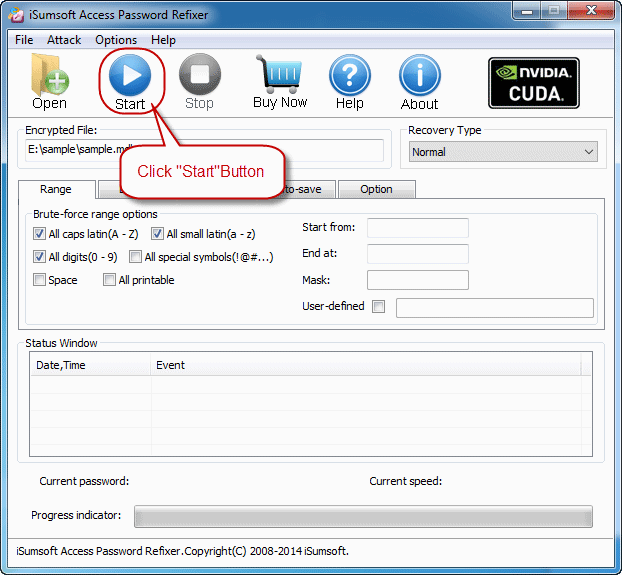
Recovery time depends on password complexity, the search settings, and your computer. A larger search may run for a long time, and it may not find the password. The time shown in a sample screenshot is not an estimate for your file.
If you need to interrupt the search, review Auto-save before closing the program.
Step 4: Use your recovered password
1If a password is found, the program displays a recovery result. Click Copy beside the database password.
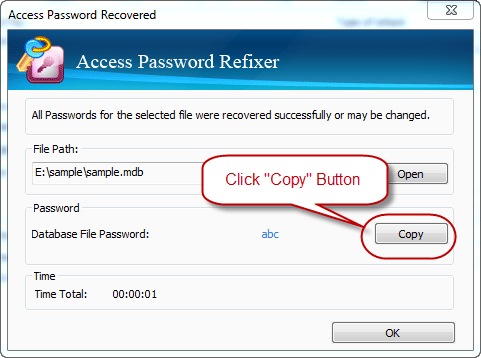
2Open your backup copy of the database in Microsoft Access and paste the password into its password prompt. Confirm that you can open the database and read the expected content before treating the recovery as complete.
Store the recovered password securely. Avoid including it, or the contents of your database, in screenshots sent to support.
Recovery mode settings
Use these settings when you have clues that can narrow the search. You can also read the Dictionary and Mask recovery guide.
Mask: use the part you remember
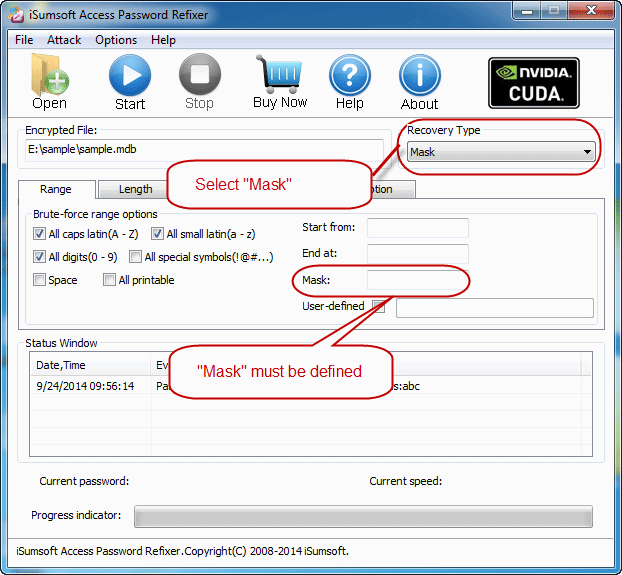
Select Mask from Recovery Type and define a password mask in the Range tab. Follow the mask syntax shown by your installed version; do not assume that an unknown-character symbol works the same in every program.
Dictionary: try likely passwords
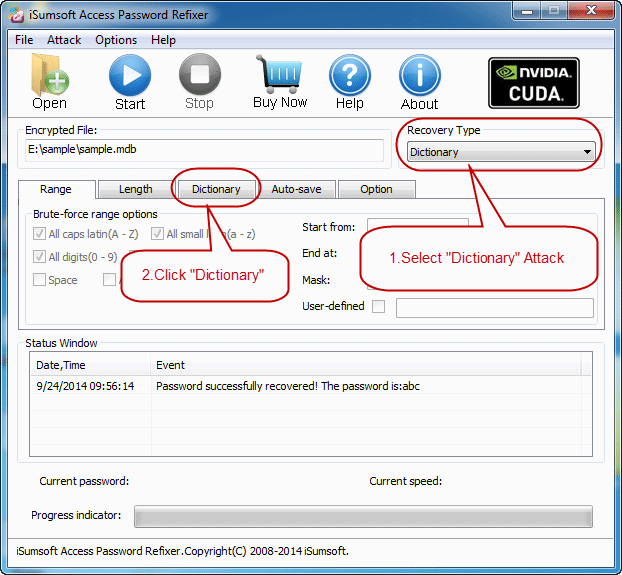
1Select Dictionary from Recovery Type, then open the Dictionary tab.
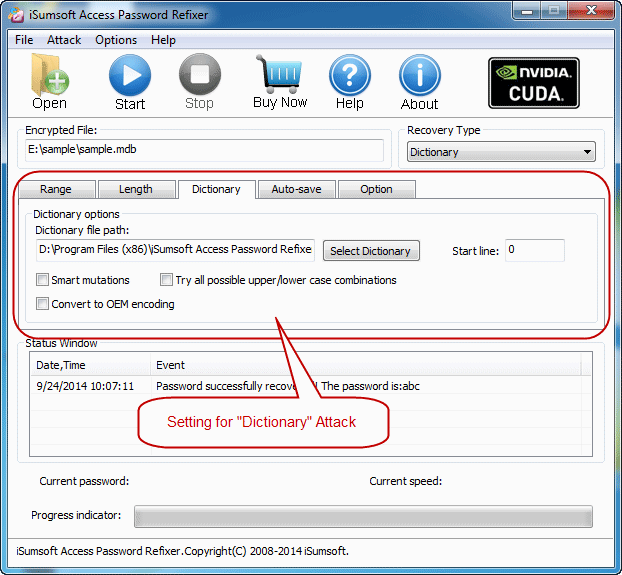
2Click Select Dictionary to choose your word list. Review Smart mutations and Try all possible upper/lower case combinations if those variations fit your password clues. Trying more variations increases the work required.
Range, length & auto-save
Range: choose possible characters
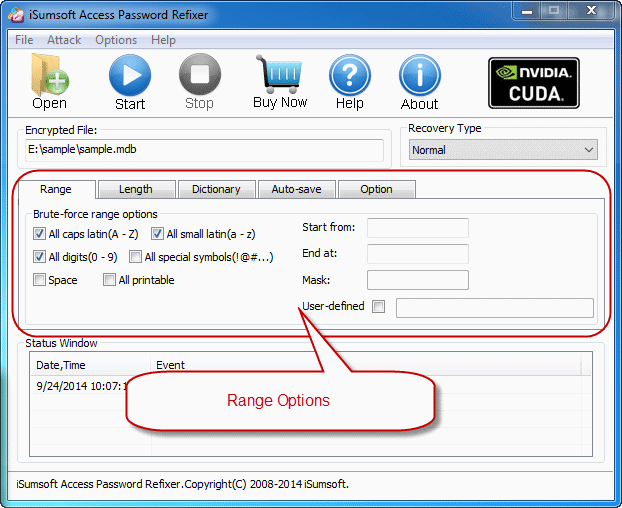
In the Range tab, review the character groups to search, such as uppercase letters, lowercase letters, digits, and symbols. Exclude a group only if you are certain the password does not contain it.
Length: set a realistic search range
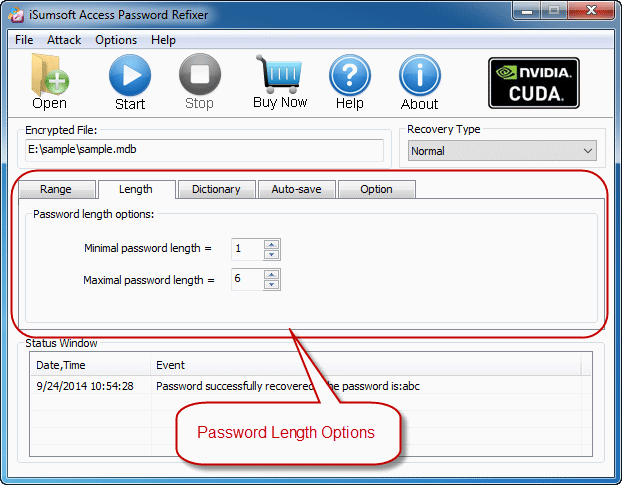
In the Length tab, set the minimum and maximum possible password length. If you are unsure, avoid making the range so narrow that it excludes the real password.
Auto-save: prepare for interruptions
Open the Auto-save tab and review the available progress-saving options before a long recovery session. Enable auto-save if you want to resume later, and keep the saved progress and database copy available. After reopening the program, check that your saved job is restored before continuing.
Troubleshooting
Find your issue below for checks and next steps.
The database will not open in the recovery tool
Check that you selected the intended file, that it is available locally, and that its format and Access version match the supported formats and versions. Work with a backup copy. If the program shows an error, record the exact message for support; password recovery and repairing a damaged database are different tasks.
The search is taking a long time or finds no password
Review the recovery type, character range, and password length. For Mask, recheck every known position; for Dictionary, check whether your word list includes plausible candidates. Incorrect restrictions can exclude the real password. Expanding the search may help cover more possibilities, but also increases the time required. Success is not guaranteed.
I need to close the program and continue later
Review the Auto-save settings and confirm that progress has been saved before closing. Keep the database and saved job available. If the program does not restore the job, contact support with the software version and the steps you took.
The copied password does not open my database
Confirm that you are opening the same database used for recovery and that no extra spaces were added when pasting. If the prompt refers to a different account or protection type, do not assume the recovered database-opening password applies to it. Record the exact Access error and ask support to check the case.
Where can I check trial and license details?
Review the messages in your installed program and the purchase page. If you cannot tell what the trial will reveal for your file, contact support before purchasing. A license does not guarantee that every password can be recovered.
Still need help with your database?
Tell us your Windows and Access versions, the Access Password Refixer version, file extension, selected recovery mode, and exact error message. Remove passwords and personal information from screenshots.
 Excel password recovery guide
 PDF password recovery guide